
Structuring work
Initiated in 2024 under the leadership of Mr. Tevaiti-Ariipaea POMARE, then Minister of Economy, and now thanks to the enthusiasm of Mr. Warren DEXTER, the current minister, preliminary work to structure the Social and Solidarity Economy (SSE) in the territory will continue until the end of 2025.
This deeply humanitarian and solidarity-based vision questions how entrepreneurship should be approached in a socio-economic context that is currently weakened by numerous internal and external factors affecting our society. It is now essential to be able to devise responses and formulate sustainable solutions that will enable us to gain individual and collective autonomy and to work together to ensure that Polynesian society has greater resilience, which is essential for facing present and future challenges.
This new way of doing business, already at the heart of the population’s DNA in its traditional and community-based organization, steeped in solidarity and deeply respectful of the surrounding biodiversity, will enable the emergence of many concrete responses to the societal and economic challenges currently facing our society.
The official announcement of this initiative was made at the Council of Ministers meeting at the end of May 2024, presenting the nature of the work aimed at framing and structuring the SSE in the territory: all ministries were invited to participate in the preliminary work, with the aim of enabling the most comprehensive interministerial approach possible.
It should also be noted that this work is being carried out with the financial support of the French Development Agency (AFD) in Papeete and the assistance of ESS France Outre-mer.
“World Café” consultation workshops – March & April 2025
To provide a solid framework for this economic model, the Economic Development Agency (ADE) and ESS France Outre-mer, with the support of the French Development Agency (AFD), have begun preparatory work on drafting a law on the SSE in French Polynesia. This law will help structure and strengthen the sectors concerned and make the SSE a real lever for economic and social development.
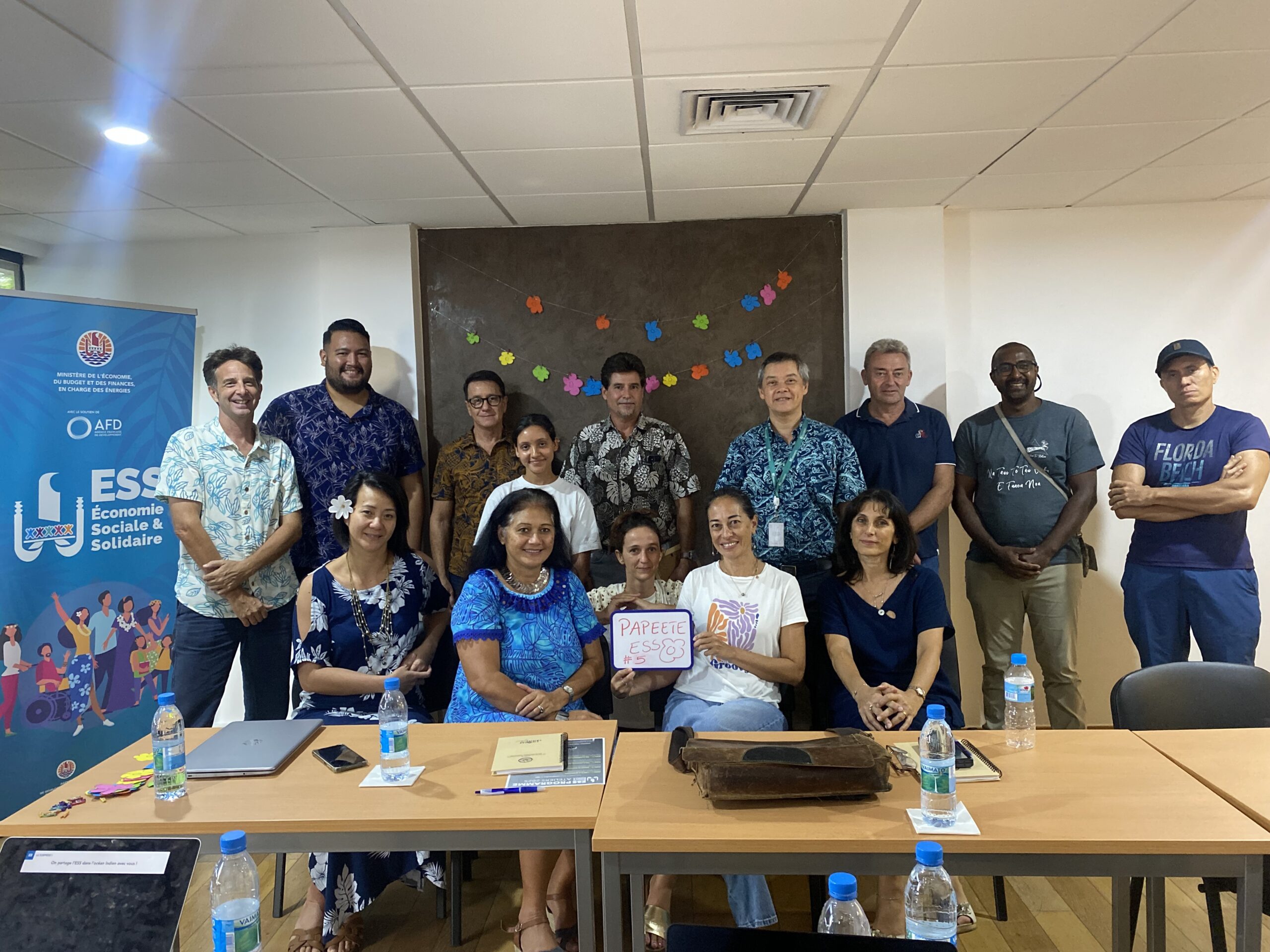
In order to gather input from socio-economic actors, two teams from ESS France Outre-mer led a dozen “World Café” consultation workshops between mid-March and the end of April 2025 in Tahiti and several Polynesian islands and archipelagos (Papeete, Faa’a, Terehē amanu, Moorea, Ra’iā tea, Manihi, Nuku Hiva).
Focusing on four major themes, these consultation workshops addressed several key topics in order to identify the expectations and needs of as many stakeholders as possible:
Theme 1: The SSE and its governance
How can local values be embedded and SSE actors recognized in French Polynesia?
Theme 2: Financing and supporting the SSE
What tools and mechanisms are needed to support SSE enterprises and initiatives? Focus on access to financing, technical support, and local cooperation.
Theme 3: The SSE and public procurement
How can the SSE be integrated into public procurement to promote more social and sustainable economic development? Levers and opportunities in public procurement, such as socially and environmentally responsible purchasing (SERP) or the inclusion of social and environmental clauses.
Theme 4: SSE and public policy
What place does the SSE have in French Polynesia’s economic and regional integration strategies? Opportunities and collaborations to be strengthened, particularly with Pacific countries.